
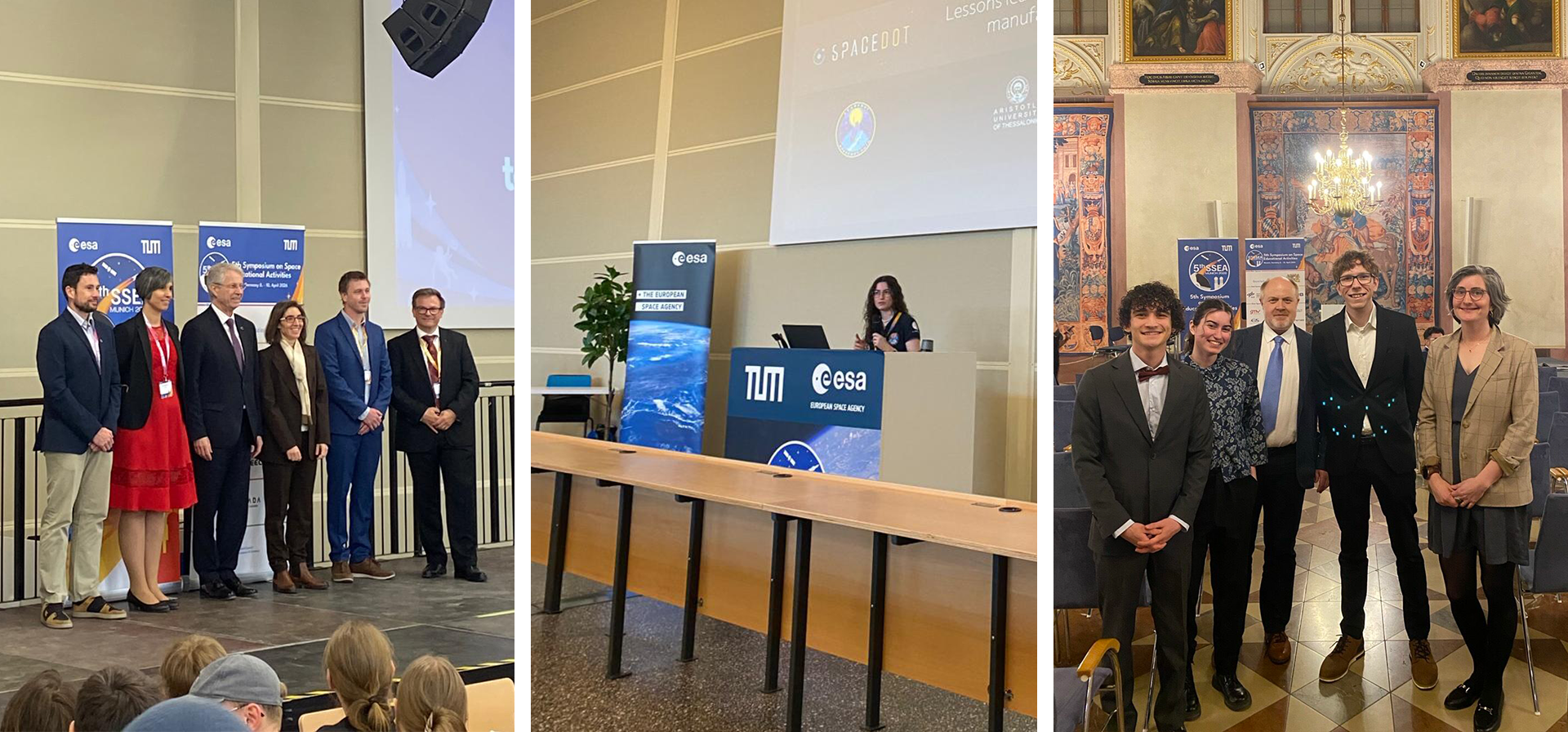
From 8–10 April 2026, the EPFL Space Center took part in the 5th Symposium on Space Educational Activities (SSEA), contributing two student presentations and sharing an exhibition stand with fellow Swiss institutions. Hosted by the Technical University of Munich (TUM) in collaboration with ESA and its partners, the event drew more than 500 participants — making it the largest edition in the symposium's history.
Student Presentations
Emmanuelle David, EPFL Space Center's Executive Director, presented a paper co-authored with Maximilian Bovin, President of the EPFL Rocket Team: Bridging Academia and Industry: A Comparative Analysis of Systems Engineering Implementation in Student Space Projects. The paper draws on ongoing research into systems engineering practices across EPFL's student space teams.
Emilien Coudurier, Lead Engineer at the EPFL Spacecraft Team, presented work from a previous project: Failure-Tolerant and Power-Optimal ADCS Design for 3U CubeSats — a strong international debut for the team.
A third paper from the EPFL community was also featured: NEST: A Modular Framework for Reproducible Software-in-the-Loop Testing of Spacecraft Systems, authored by Nathan Felber, Vincent Fiszbin, Hugo Noublanche, Alessandro De Zen, Quentin Sandoz, and Emma Anastassova.
Christina Athanasiadou, an engineer who recently joined the EPFL Space Center, presented a paper on the AcubeSAT mission — sharing lessons learned from the design and early manufacturing phases of the project, developed at the Aristotle University of Thessaloniki.
Connecting with the ESA Education Office
The conference provided a valuable opportunity to engage with the ESA Education Office on several fronts: scholarship opportunities for students attending short courses; use cases for spacecraft design courses to be published on the ESA website; an upcoming mapping of student space associations through ESA's student outreach initiative; and the launch of a new student rocketry programme.
A Joint Swiss Presence
The EPFL Space Center shared an exhibition stand with ETHZ and HSLU, supported by Space Exchange Switzerland — a visible demonstration of what Swiss institutions can achieve through collaboration. The stand attracted considerable interest, particularly around study and career opportunities in Switzerland.
A Full Conference Experience
Beyond the formal sessions, attendees took part in industry visits across the Munich area, including tours of the European Southern Observatory and the DLR Control Center. For students attending an international conference for the first time, the experience offered the complete journey — from abstract submission and peer review to presenting original research before an international audience.
"A proud moment for the team, and a great opportunity to connect with the broader space education community." — EPFL Spacecraft Team on LinkedIn
More on the event: 5th Symposium on Space Educational Activities — ESA