
The EPFL Rocket Team on the hunt for a launch pad
As the EPFL Rocket Team prepares the next steps of its ambitious spaceflight projects, “reach space” one critical question is taking center stage: where could an EPFL student rocket safely and efficiently be launched?
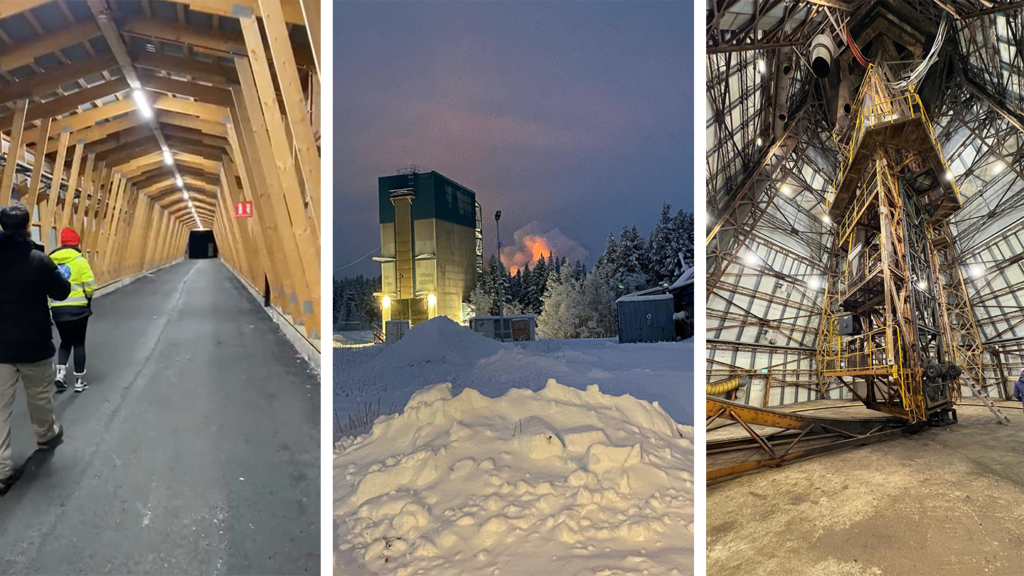
To explore potential answers, Emmanuelle David, Executive Director of the EPFL Space Center, visited the ESRANGE Space Center in Kiruna, Swedish Lapland, in December 2025. This visit marked an important milestone in assessing future launch opportunities for EPFL’s student-led space initiatives.
The ESRANGE Space Center
Located about 40 kilometres east of Kiruna and managed by the Swedish Space Corporation (SSC), ESRANGE is one of Europe’s most iconic space infrastructures. The site benefits from a vast, unpopulated impact and recovery area, making it particularly well suited for experimental launches.
ESRANGE offers a wide range of capabilities, including:
- Launches of sounding rockets
- Stratospheric balloon missions
- Propulsion tests
- Drop tests for space and aerial vehicles
Today, the facility serves the international scientific community, supporting research in microgravity, atmospheric physics, and astronomy. It also hosts one of the world’s largest civilian satellite ground stations, acting as a key hub in a global satellite network.
A site steeped in space history
Kiruna’s role in space research dates to the late 1940s, when scientists began installing facilities to study the upper atmosphere using sounding rockets. Thanks to its high latitude, the region is uniquely positioned to collect valuable data on the Earth’s magnetosphere and the structure of high atmospheric layers.
The ESRANGE launch base itself has been operational since 1966, and what started with just five people has grown into a regional space industry employing around 500 professionals, including approximately 180 at SSC/ESRANGE Space Center alone.
Learning from the experts
Beyond infrastructure, ESRANGE is also a hub for knowledge exchange. For those curious about the types of experiments launched from Kiruna, the European Space Agency regularly hosts events and workshops. One such opportunity is detailed here.
More background on the broader Kiruna ground station can also be found on ESA’s website.
Acknowledgements
A big thank you to Marie Lambert and Armelle Frenea-Schmidt for organizing this insightful and inspiring visit. Their efforts made it possible to connect EPFL’s student ambitions with one of Europe’s most remarkable space facilities.