
- This event has passed.
EPFL Space Center – Seminar series: Surviving on Mars
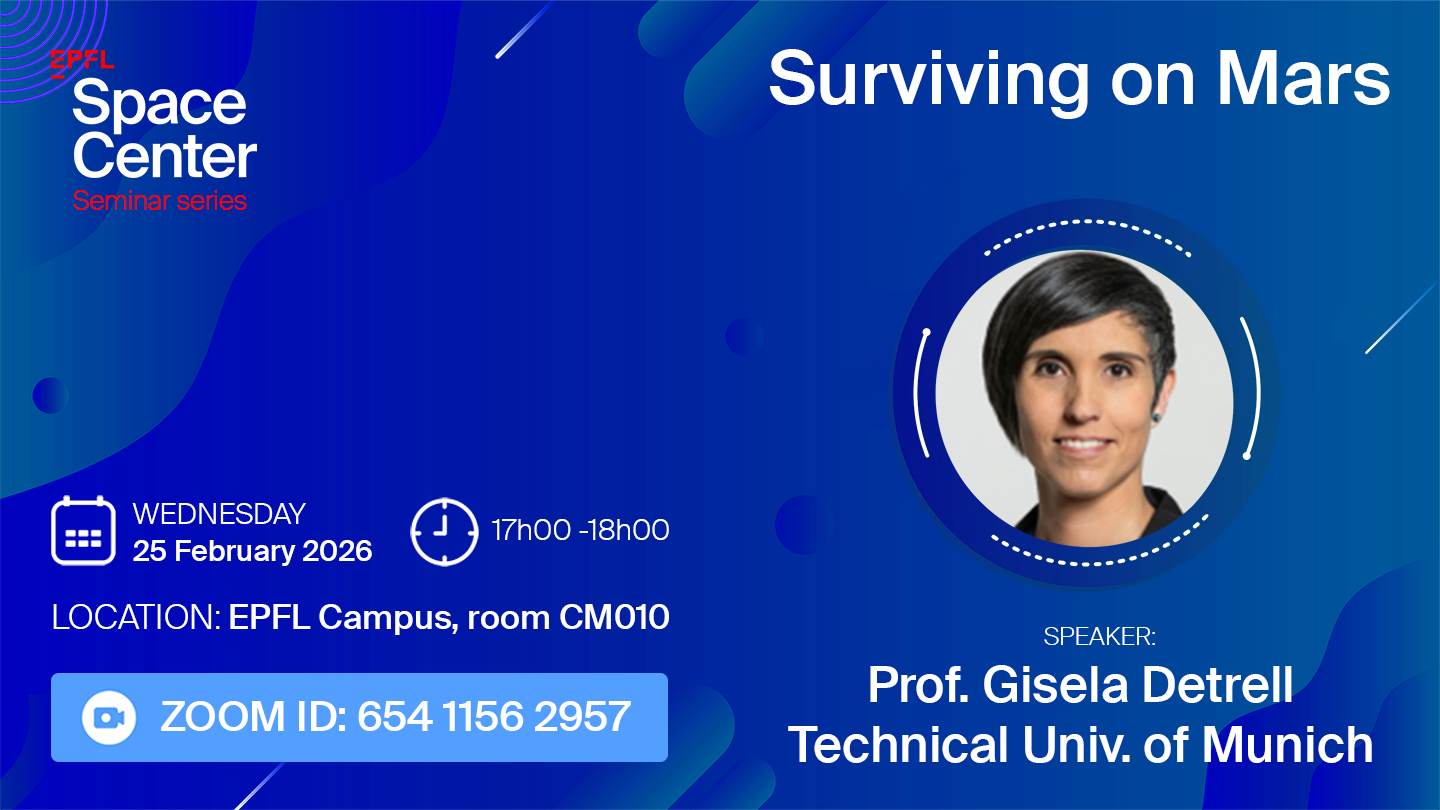
EPFL Space Center Seminar series
SURVIVING ON MARS
Future human missions to the Moon or Mars require sustainable life support systems that can provide oxygen, water, and food with minimal reliance on Earth.
Unlike the ISS, these missions will face longer durations and greater distances, demanding far more autonomous systems. Integrating biological components, especially food-producing systems, is a key challenge and opportunity. Microalgae are promising candidates due to their high photosynthetic efficiency, nutritional value, and contribution to oxygen and water recycling. Current research explores whether ISS technologies can be adapted for deep-space missions and what innovations are needed. A central question remains whether astronauts will rely on stored food or grow their own, maybe with algae as part of the menu?
Prof. Gisela Detrell's field of research is the development of technologies to enable human spaceflight, with special focus on Life Support Systems Technologies (specially on the use of microalgae photobioreactors for oxygen and food production for long duration missions), human spaceflight simulation (for example with conceptual design studies of future human spaceflight missions to the Moon or Mars) and human spaceflight performance (for example with the development of Virtual Reality tools, to develop and improve training strategies).
Prof. Detrell studied Aerospace Engineering at the Polytechnic University of Catalonia (UPC) and completed her doctorate in Life Support Systems reliability analysis for long duration space missions at the University of Stuttgart (Germany) and the Polytechnic University of Catalonia in 2015. She continued her research at the Institute of Space Systems in Stuttgart, leading the research group since 2018. In 2023 Prof. Detrell was appointed to the professorship for Human Spaceflight Technology at TUM.